


Key Takeaways
- Facial recognition can verify who is on a construction site, tie workers to training and orientation records, and strengthen construction workforce compliance across Middle and East Tennessee.
- Biometric attendance and access control help reduce payroll errors, buddy punching, and unauthorized site access when implemented with clear policies and human oversight.
- Tennessee contractors must balance AI-enabled access control with OSHA safety expectations and EEOC privacy and discrimination guardrails, not treat technology as a stand-alone solution.
- A practical one-site pilot approach, defined governance roles (HR, safety, project management), and pointed vendor questions should precede any broader rollout across multiple construction sites.
- ABC Greater Tennessee offers safety programs, Construction Trades Academy training, and a practical AI adoption roadmap that supports compliant technology decisions for member firms.
Why Construction Workforce Compliance and Identity Control Matter Now
Construction workforce compliance means proving that every construction worker on a jobsite is who they claim to be and meets all required safety, training, and contractual conditions for that project. Construction companies must navigate a framework of federal, state, and industry-specific regulations, and projects often require adherence to both federal and state requirements. In Tennessee’s current labor market, with roughly 168,500 construction employees and statewide unemployment at just 3.4%, compliance frameworks guide construction teams through regulations that grow more complex as project volume rises.
Contractors around Nashville, Knoxville, Chattanooga, and the Tri-Cities face intense schedule pressure. Transient subcontractor crews, multiple employers on one construction site, manual sign-in sheets, and badge sharing all undermine both compliance and safety planning. Safety regulations protect construction workers’ lives on site, and non-compliance can lead to project delays and financial penalties. Compliance failures can cause costly delays and regulatory penalties, and workforce compliance is essential to protecting a contractor’s reputation and bidding power.
The core problem facial recognition aims to solve is a simple compliance question: who is actually on the construction site right now, and does that specific worker meet the project’s requirements and have clearance for specific tasks? That answer matters because labor costs represent 30 to 50% of total construction project costs, and contractors also need accurate records of work hours when 3.2 to 3.6% of the construction workforce is absent on any given day. Getting identity and attendance wrong costs more than it used to.
Why Traditional Site Sign-In and Access Control Fall Short
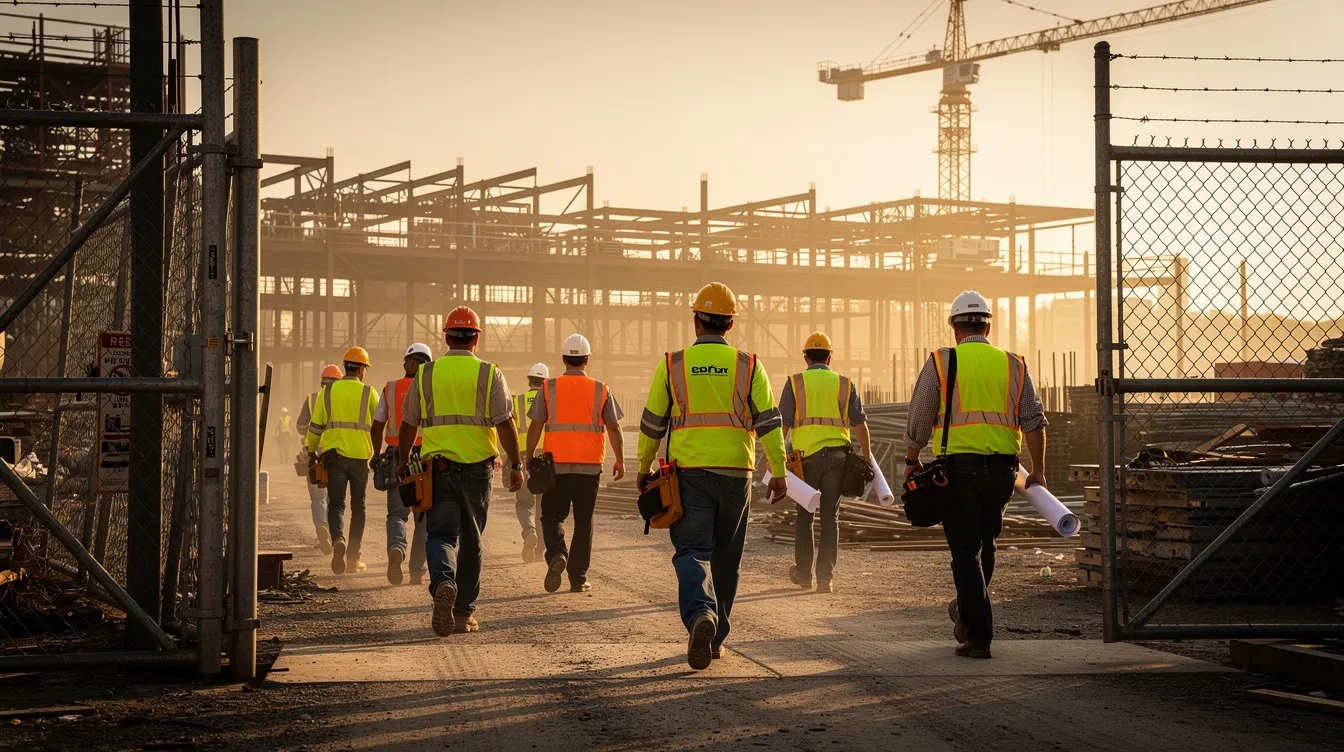
Most construction sites still rely on paper sign-in sheets, generic badges, shared PIN codes, and manual gate logs to track who enters and leaves. These methods are cheap to set up, but they do not reliably verify identity.
Here is where those systems consistently fail construction workforce compliance:
- Buddy punching and time theft: One worker signs in for another who is late or absent. Biometric systems eliminate buddy punching in attendance tracking; manual methods cannot.
- Unreadable or incomplete records: Handwriting is illegible, entries are skipped, and end-of-day aggregation is error-prone.
- Lost or shared badges: A badge verifies a card, not the person holding it.
- Delayed credential updates: Workers whose certifications lapse may continue accessing the site because no one cross-checked the database in time.
- No real-time visibility: Supervisors managing multiple projects cannot see, minute to minute, which construction crews are present.
Employers must verify worker identity and work authorization using Form I-9, but weak physical access control creates gaps far beyond immigration compliance. Unplanned absences cause 36.6% productivity loss, and when attendance data is unreliable, that loss is invisible until payroll disputes, OSHA recordkeeping problems, or liability questions surface after an incident.
How Facial Recognition Biometric Systems Work on Construction Sites
Biometric systems use unique physiological characteristics to authenticate users. In facial recognition, an enrolled template (a mathematical representation of facial features, not a raw photo) is compared against a live image captured at a gate or check-in point. Biometric access control systems enhance security by preventing unauthorized access, and biometric attendance systems can accurately track employee presence.
A typical workflow on a Tennessee construction site looks like this:
- Enrollment: During onboarding, a worker’s face is scanned and converted into an encrypted template that the construction company or its provider stores.
- Check-in: At the site entrance, the worker faces a tablet, rugged terminal, or IP camera. The system quickly matches the live image against the stored template, often in under a second.
- Verification: If the match succeeds and compliance records are current, the system clears the worker. If not, supervisors are alerted.
These systems can operate offline and sync later, which matters on remote infrastructure jobs where cell coverage is weak. Machine-learning models improve matching under hard hats, safety glasses, and variable lighting. Technology can help manage compliance through digital onboarding and credential tracking, and biometric technology spending in Europe alone will reach $6.1 billion by 2026, reflecting the scale of global adoption.
This is not a deep engineering challenge for the contractor. The key distinction is between attendance tracking (recording time on site for payroll and compliance) and physical access control (restricting entry so only verified, approved workers pass through gates or turnstiles). Most systems can control access and track attendance.

From Identity Check to Construction Workforce Compliance
The real value for construction workforce compliance appears when facial recognition is linked to a central system that already stores orientation records, OSHA and site-specific training, medical clearances, and trade credentials. OSHA mandates protocols to protect workers from falls, electrocution, and other hazards, and OSHA standards are primarily governed by 29 CFR 1926 for the construction industry. Compliance with OSHA significantly reduces job site accidents and fatalities.
Consider a scenario: a worker arrives at a Nashville healthcare project. The system verifies their face, then automatically checks whether their confined space or infection-control training is current and whether they are cleared for specific tasks before granting site access. If the training expired yesterday, the system flags the gap before the worker reaches the active work area.
This link reduces manual cross-checking for safety managers and supports audits and client prequalification reviews by creating clearer evidence trails. Regular audits help identify compliance issues early in projects, and effective compliance systems enhance workforce management and accountability across construction sites. Accurate attendance records improve compliance with labor regulations, support stronger bid packages, and reinforce the identity-plus-requirements logic that matters most: “Is this person really John Smith, and is John Smith currently cleared to work here today?”
Reducing Payroll Errors, Attendance Fraud, and Disputes
Biometric systems prevent time theft through buddy punching, and accurate, time-stamped attendance tracking cuts ghost workers and mismatches between time on site and billed hours. Automated time tracking significantly reduces payroll errors by capturing accurate work hours, which matters when construction firms must comply with wage-and-hour laws like the Davis-Bacon Act and the Fair Labor Standards Act, which governs minimum wage, overtime, and recordkeeping.
For large projects along the I-24 or I-40 corridors, reliable jobsite attendance records support cleaner payroll runs, fewer payroll errors, better labor cost control, and less time for office staff to spend reconciling timesheets. Real-time attendance tracking lets managers adjust schedules immediately and provides the data they need to see which crews were present when milestones slipped or change orders were executed.
Proper worker classifications help avoid misclassification lawsuits and penalties. Higher injury rates can increase workers’ compensation costs for construction firms, and maintaining workforce compliance helps control costs related to fines and legal fees. Construction compliance prevents costly fines and legal disputes. While biometric systems cannot eliminate all disputes, they give Tennessee construction companies stronger records to support their position in conversations with owners, general contractors, or subs. Cleaner attendance data also improves resource allocation, schedule accuracy, and the project success metrics construction teams rely on for profitability.
Legal, Privacy, and Ethical Guardrails for Biometric Access Control
Facial recognition is powerful, but it creates legal issues and ethical responsibilities. Companies must adhere to Equal Employment Opportunity Commission guidelines to prevent discrimination. EEOC guidance is clear: biometric tools must be job-related and consistent with business necessity, cannot discriminate based on protected characteristics, and must allow for reasonable accommodation where needed.
Key data-privacy responsibilities for Tennessee contractors include:
- Informed consent: Explain what biometric data is collected, why, and how long it is retained.
- Secure storage: Encrypt templates; avoid storing raw face images when possible.
- Access limits: Define who can view attendance data and biometric records.
- Deletion protocols: Establish retention schedules and follow them.
Common risk scenarios to manage include relying blindly on an algorithm’s decision to deny access, failing to offer non-biometric options in medically justified cases, or using facial recognition data for purposes workers never agreed to. Environmental regulations require construction operations to manage hazardous materials and site runoff, and ignoring compliance in any domain can damage a construction company’s reputation. Tennessee does not currently have a biometric privacy statute equivalent to Illinois’s BIPA, so contractors must rely on internal policies, consent, and legal review rather than assuming no obligation exists.
Read the fine print of any vendor contract and have legal counsel review your proposed biometric policy before deployment.
Where Facial Recognition Fits in Tennessee Jobsite Workflows
A typical morning on a construction site in Middle or East Tennessee involves hundreds of construction workers arriving within a narrow window. Here is where facial recognition interacts with existing workflows:
| Workflow Step | Facial Recognition Role | Human Role |
|---|---|---|
| Gate arrival | Authenticate users against enrolled templates | Gate guard monitors queue, handles exceptions |
| Compliance check | System flags expired training or credentials | Supervisor decides whether to grant temporary access |
| Attendance logging | Records exact arrival and departure times | Office staff reviews data for payroll processing |
| Safety observation | Confirms only cleared workers are in active areas | Foremen conduct toolbox talks and visual checks |
| Incident response | Provides a time-stamped record of who was on site | Safety director manages investigation and reporting |
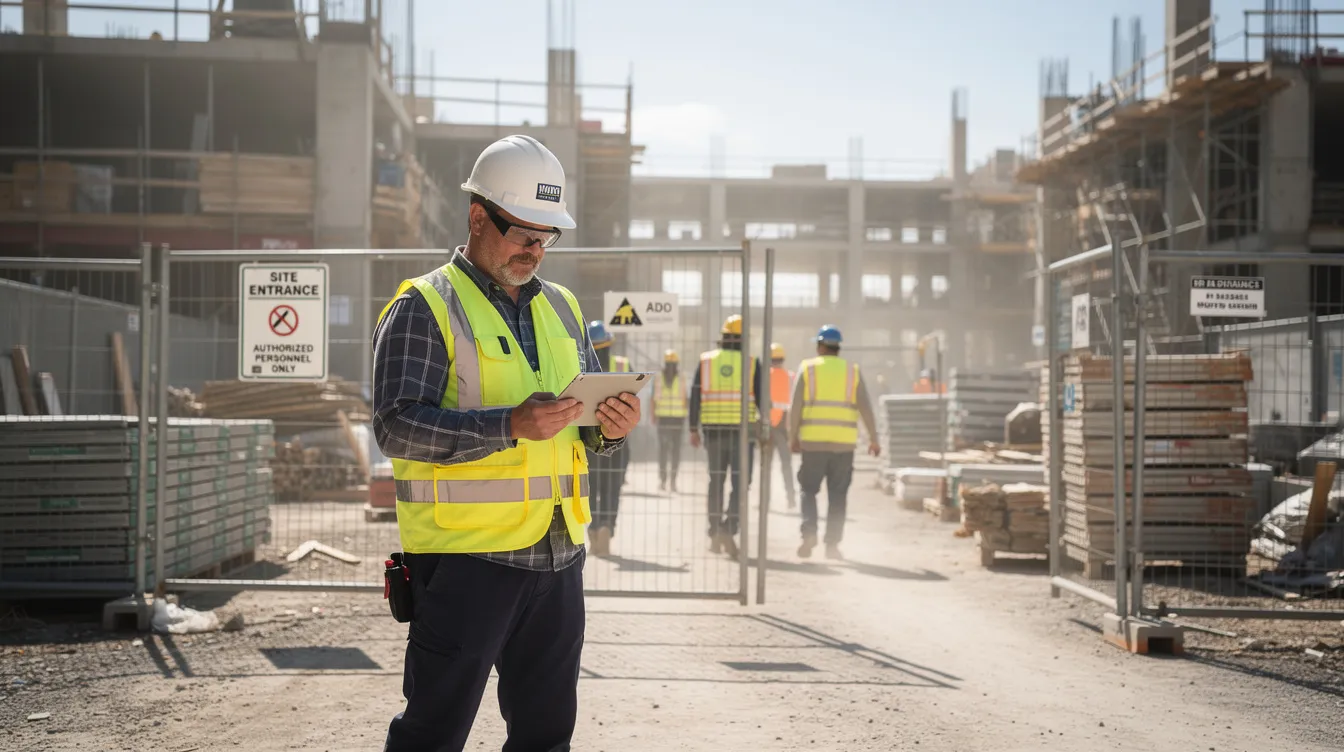
Supervisors, gate guards, and foremen still play a crucial role. The system provides real-time insights and alerts, but managers still have to act on those prompts within the site access process rather than delegate decisions entirely to software. Facial recognition should be configured to minimize friction at shift change, adapt to night work or multiple shifts, and function even when connectivity is limited on remote infrastructure jobs. Mobile devices and rugged terminals mounted at entry points handle the capture, while GPS tracking and geofencing help control access at the project boundary.
How to Pilot Facial Recognition on One Construction Site
A disciplined pilot starts small. Here is a recommended structure:
- Select one project: Choose a site in Middle or East Tennessee with motivated leadership, a single entrance or gate, a stable crew size, and a clear construction workforce compliance objective (for example, reducing mismatched attendance and payroll errors over 90 days).
- Build the team: Involve HR, IT, safety, and field supervision from the start. Assign a compliance owner.
- Brief construction workers: Hold toolbox-style meetings explaining the system, privacy protections, and fallback procedures before enrollment begins.
- Enroll during orientation: Capture templates during a scheduled onboarding window, not at the gate on day one.
Metrics to monitor during the pilot:
- False match and false non-match rates
- Time per person through access control at peak shift change
- Number of access denials that reveal real compliance gaps versus system errors
- How often manual overrides are required
- Comparison of biometric logs with existing attendance tracking records
The goal is to quantify whether the system materially improves accuracy, reduces payroll corrections, strengthens audit trails, and delivers measurable benefits during the pilot. Even for small projects, this comparison matters because it helps leaders weigh operational value against implementation cost. Productivity loss from unplanned absences runs at 36.6%, and the best systems prove their value by making that loss visible and manageable.
Governance: Who Owns Construction Workforce Compliance Data?
Biometric access control touches multiple functions, so Tennessee contractors should assign ownership before rollout, not after a data incident forces the question.
- HR or compliance officer: Owns policies, notice and consent language, data-retention rules, and accommodation procedures. Ensures the company can stay compliant with evolving state and federal requirements.
- Safety leaders and project managers: Own day-to-day jobsite application, aligned with OSHA expectations for hazard identification, worker training verification, and recordkeeping.
- IT or security teams: Evaluate vendors, manage encryption and system integrations, and ensure that biometric templates, attendance logs, and training records remain secure and backed up.
Regular reviews of construction workforce compliance data, using a defined review process to guide action on staffing shortages, training gaps, and repeated access denials, turn governance into an ongoing management discipline rather than a one-time technology purchase. This additional layer of accountability strengthens the entire compliance program. An iris scanner or RFID cards may supplement facial recognition in specific scenarios, but the governance structure remains the same regardless of which biometric devices are in use.
How ABC Greater Tennessee Can Support Safer, Compliant Technology Adoption
ABC Greater Tennessee helps contractors weave facial recognition into a broader safety and compliance culture rather than treating it as a game changer that works in isolation. The chapter’s safety programs, including STEP participation and OSHA collaboration, give members a structured framework to integrate new technologies into written safety and compliance plans.
Construction Trades Academy training builds a more prepared construction workforce, with credentials and training records that can connect to modern attendance tracking and access control systems for stronger compliance evidence. For contractors evaluating facial recognition pilots, the chapter’s practical AI adoption roadmap, AI construction ROI framework, and AI-ready technology checklist resources support disciplined planning.
Next step: Contact ABC Greater Tennessee to discuss safety, compliance, and technology strategy support before rolling out biometric systems widely across your construction sites.
Conclusion: Start Small, Stay Compliant, and Measure Real Value
Facial recognition on construction jobsites is most valuable when it solves a narrow but critical problem: proving who is on site and whether each worker meets project requirements for safe, compliant work. Success depends on written policies, transparent communication with construction workers, and alignment with OSHA safety expectations and EEOC anti-discrimination principles, not on software alone.
The recommended path for Tennessee contractors: pick one jobsite, define a clear compliance and attendance tracking goal, involve cross-functional leaders, and evaluate biometric access control against current methods before scaling up. Treat facial recognition as one disciplined tool within a broader construction workforce compliance strategy that includes training, supervision, and continuous improvement.
Start by convening a short internal meeting to map current access control and attendance tracking practices at your highest-priority project. Identify the specific gaps, assign an owner, and engage ABC Greater Tennessee for guidance on designing a compliant, measurable pilot.
FAQ
Below are answers to common questions about this topic.
Is facial recognition mandatory for construction workforce compliance, or just one option?
No law currently requires Tennessee construction companies to use facial recognition on construction sites. It is one optional tool among several for improving attendance tracking, access control, and compliance documentation. Smaller construction companies or low-risk projects may continue using simpler attendance-tracking systems like RFID badges, RFID tags, or GPS-enabled apps. Larger or higher-risk construction sites with multiple employers tend to see more benefit from biometric systems. Base the decision on project risk profile, client expectations, and current pain points, not on technology trends alone.
What happens if facial recognition cannot identify a worker at the gate?
Well-designed jobsite procedures should include a clear fallback: a documented process for manual identity verification by a supervisor using government ID, cross-checking with enrollment records, and, if needed, temporary entry with conditions. Define and document these exception paths in your access control policy so a failed match does not cause unsafe crowding at the gate or unfairly block qualified employees. Persistent no-matches should trigger a review of enrollment quality, camera placement, lighting, and worker PPE to improve recognition without compromising safety gear requirements.
How should contractors talk to workers about biometric attendance and privacy?
Provide a simple, plain-language notice explaining what facial recognition is, why the company is using it on construction sites, what data is captured, how it is protected, and how long it will be retained. Hold short, toolbox-style briefings before rollout, giving construction workers a chance to ask questions about privacy, discrimination concerns, daily workflow impact, and the system’s benefits. Document this communication and provide ongoing contact points for concerns, which both supports trust and strengthens the company’s position if regulators or clients review its compliance program.
Can facial recognition data be used for performance management or discipline?
While attendance tracking records often inform performance conversations, contractors should be cautious about expanding biometric data use beyond what workers were told and beyond what is necessary for legitimate business purposes. Review any use of biometric attendance data in discipline or termination decisions for fairness, accuracy, and potential disparate impact on protected groups, ideally with input from HR and legal counsel. Transparent policies that distinguish between safety and access-control purposes and broader monitoring help Tennessee contractors avoid perceptions of excessive surveillance.
How do we choose a facial recognition vendor for construction sites in Tennessee?
Focus on high-level selection criteria: strong accuracy in outdoor and PPE conditions, clear data-protection practices, support for offline operation, integration with existing attendance-tracking systems and HR software, experience with construction-industry deployments, and total cost. Ask vendors specific questions about where biometric templates are stored, how they are encrypted, how long data is retained, how the system can control access to sites or restricted areas, and how the system supports compliance with OSHA recordkeeping and EEOC guidance. Use internal resources and structured evaluation methods to avoid committing to systems that don’t fit your company’s scale, location, or compliance needs across multiple projects and timelines.