Project controls work best when field teams and office leaders review the same current jobsite reality. For Tennessee contractors managing work across Nashville, Knoxville, Chattanooga, the Tri-Cities, and the I-40, I-75, and I-24 corridors, drones can help create that shared view when tied to a specific reporting routine instead of treated as a standalone tech purchase.
According to ABC National’s August 17, 2026 news release reporting on a May 2026 member survey, 36.1% of surveyed ABC contractor members reported using drones on job sites, and 80.8% of those users cited progress monitoring as a primary use. That does not mean every contractor needs an in-house drone program. It does mean drone use is established enough to evaluate as an operating tool inside project controls construction.
This guide stays narrow on purpose. It is not a broad construction-technology overview or a safety-tech roundup. It is a practical decision tool for one question: would drone documentation improve an existing project-controls workflow on your jobs?
Key Takeaways
- Project controls construction is about comparing plan versus field reality so teams can make better schedule, cost, documentation, and coordination decisions.
- ABC National reported on August 17, 2026, that 36.1% of surveyed contractor members used drones on job sites, and 80.8% of those users cited progress monitoring as a primary use.
- Drones are most useful when they support a recurring management routine such as weekly progress review, logistics planning, quantity observation, or stakeholder updates.
- A limited pilot is usually a better first step than launching a full internal drone program.
- The most practical test is whether drone output helps your team spot issues sooner and discuss them more clearly, not whether it delivers instant ROI.
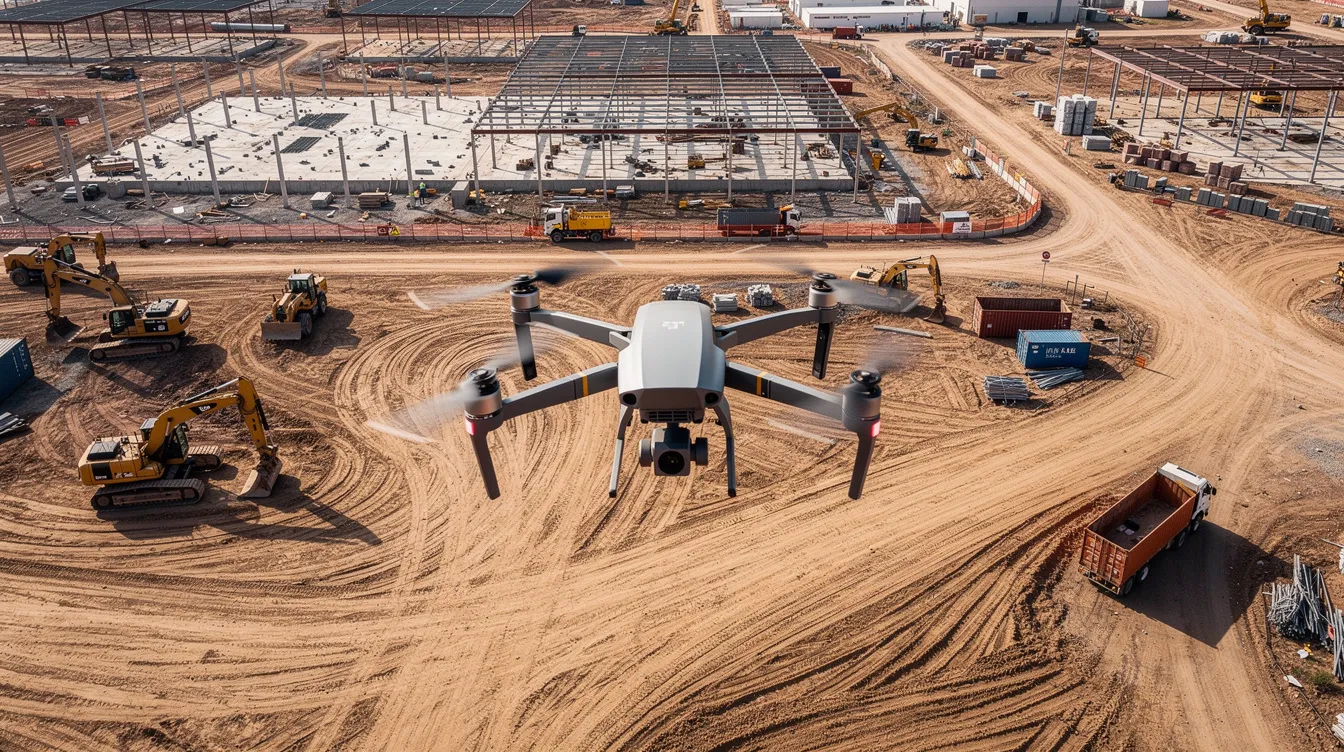
What Drones Actually Add to Project Controls Construction
In practice, project controls construction is the discipline of checking what was planned against what is happening now. Teams use it to review progress, spot variances, document conditions, and decide where leadership needs to act before a problem grows.
Drone imagery does not replace scheduling, cost reporting, inspections, or superintendent judgment. It adds a repeatable visual record that teams can review alongside the tools they already use.
That matters most when leaders are asking questions such as:
- Does visible field progress match the activities reported for this phase?
- Are staging, access, or laydown conditions creating downstream coordination problems?
- Do we have clear documentation for owner updates, pay discussions, RFIs, or disputed conditions?
- Is there a site condition that needs escalation before the next trade mobilizes?
If drone files never make it into those conversations, they are not improving project controls construction. They are just more stored media.
When a Drone Pilot Is Worth Testing
The best use case is not “we should have drones because other contractors do.” The better test is whether your current workflow has a visibility gap that recurring aerial documentation could solve.
| Job condition | What that suggests |
|---|---|
| Leaders oversee several active sites and cannot visit each one often | A pilot may help with recurring progress visibility and remote review |
| The project has broad earthwork, changing logistics, or hard-to-see site conditions | A pilot may help if output is reviewed in normal coordination meetings |
| Your team already struggles to organize photos, notes, and reports | Fix workflow ownership first, or drone data may add confusion |
| Most of your work is small interior renovation with limited exterior visibility value | Drones may not be the next-best project-controls improvement |
| The only reason to buy is competitor pressure | Do not start there; define the operating problem first |
For many Middle and East Tennessee contractors, the strongest first use case may be weekly progress verification on larger commercial, industrial, civil, healthcare, or distribution sites.
Observation Checklist Before You Launch
Use this checklist before assigning a pilot, buying equipment, or hiring a provider.
1. Workflow check
- Which existing meeting, report, or review will use the drone output?
- What problem are you trying to solve: progress visibility, logistics review, condition documentation, quantity observation, or stakeholder communication?
- Who will review the imagery and create follow-up actions?
- How often do site conditions change enough to justify recurring flights?
- Would a third-party service be more practical than building in-house capability first?
2. Project-controls check
- What baseline will the team compare against: the schedule, site logistics plan, progress photos, or stockpile records?
- How will findings be logged: meeting minutes, issue lists, RFIs, safety observations, or progress reports?
- What would count as a useful result after the pilot: clearer status review, faster issue escalation, stronger documentation, or better meeting efficiency?
- Which project types would benefit enough to repeat the process?
3. Compliance and risk check
- For non-recreational operations, have you addressed current FAA rules, including Part 107 where applicable, along with any relevant operating limits or authorizations?
- Are there airspace restrictions near the project?
- Do you have a plan for storing, accessing, and retaining imagery?
- Have you addressed privacy expectations for sites near occupied facilities or residential areas?
- Have safety and insurance stakeholders reviewed how drone use fits your existing procedures?
A Simple 90-Day Pilot Framework
If your firm wants to test drones inside project controls construction, keep the pilot tight and measurable.
- Choose one or two projects. Select jobs where field visibility is genuinely difficult.
- Pick one primary use case. Start with recurring progress documentation or logistics review, not five goals at once.
- Assign ownership. One operations leader should sponsor the test, and one project leader should integrate the output into routine meetings.
- Set a fixed review window. A 90-day period is long enough to see whether the process improves discussion and documentation.
- Decide whether to expand, outsource, or stop. Base the decision on usefulness inside your workflow, not on enthusiasm for the hardware.
A clearly hypothetical example: imagine a contractor with one larger project near Knoxville and another near Chattanooga. Leadership wants better weekly visibility without adding travel or building a separate reporting burden for the field. A reasonable pilot could use one recurring flight per site each week, review the imagery during the existing project meeting, and track simple observations such as issues identified, actions assigned, and whether owner updates became easier to support visually. That example does not assume dramatic savings. It simply tests whether drone documentation improves decisions.
What to Measure Without Overclaiming ROI
Instead of forcing cost-savings claims too early, track a few operating indicators the team can review honestly.
| Category | What to review during the pilot |
|---|---|
| Progress visibility | How often imagery raised a status question or confirmed visible progress |
| Documentation quality | Whether progress reports and stakeholder updates were easier to support clearly |
| Coordination | Whether meetings produced clearer action items tied to visible site conditions |
| Review efficiency | Whether the team reduced duplicate photo gathering or supplemented some routine site review effort |
| Risk awareness | Whether aerial review helped the team identify conditions that needed earlier escalation |
This keeps the evaluation grounded in observable workflow value, which is a better fit than claiming guaranteed schedule gains, avoided incidents, or precise financial return before internal evidence exists.
Limits Contractors Should Keep in View
Drones can support project controls in construction, but they also have practical limits.
Compliance is real. Non-recreational drone operations need to follow current FAA rules, including Part 107 where applicable, plus any needed authorizations.
Weather and site conditions matter. Wind, rain, dust, urban congestion, cranes, and steel can limit flight opportunities or reduce output quality.
Workflow failure is common. The aircraft is rarely the problem. It is unclear ownership for review, storage, and follow-up.
Drones do not replace required inspections. They can support planning and documentation, but they do not replace competent-person responsibilities or OSHA-required processes.
ABC National’s August 17, 2026 release also noted common hurdles among surveyed users, including training and staffing challenges reported by 43.4% and regulatory compliance concerns reported by 53.5%.
Why This Matters for Tennessee Contractors
ABC Greater Tennessee serves merit shop contractors across Middle and East Tennessee, where leaders often manage multiple projects and dispersed teams at once. In that environment, better field visibility can matter more than another disconnected software purchase.
Separately, in a February 2025 report, the Tennessee Advisory Commission on Intergovernmental Relations identified at least $77.7 billion in public infrastructure needs from July 2023 through June 2028. That does not prove drones are right for every firm. It does reinforce the value of disciplined documentation and coordination as contractors evaluate how to manage work across multiple markets and project types.
For firms considering drones as one piece of a broader operating strategy, ABC Greater Tennessee has also published Technology in Construction: A Practical Roadmap for Merit Shop Contractors in Greater Tennessee and Construction Safety Technology: A Connected Construction Playbook for Tennessee Contractors.
Next Step
Bring together your operations leader, project manager, and safety lead for a short review of one active project. Ask:
- Where do we lack reliable field visibility today?
- Would recurring aerial documentation improve an existing review process?
- Should we test that with a 90-day pilot, a third-party provider, or not at all?
That is a better starting point than buying hardware first. If your team decides the answer may be yes, use ABC Greater Tennessee’s broader construction technology roadmap to place that pilot inside a larger operating plan instead of treating drones as a one-off purchase.