Key Takeaways
Nashville’s 1925 Tennessee War Memorial Building is undergoing a restoration valued at approximately $106 million, and the scope tells a story that every Tennessee contractor should read carefully. Restoration technology refers to tools and methods for repairing damaged systems, whether structural, mechanical, or envelope-related. In practice for the construction industry, it means laser scanning, digital construction documents, BIM coordination, non-destructive testing, and specialty cleaning methods that let teams investigate, document, and execute work on historic buildings without gambling on what they cannot see.
Hidden conditions often disrupt renovation schedules and budgets, and this project is no exception. The War Memorial scope includes modernization of mechanical, electrical, and plumbing systems, accessibility upgrades, exterior cleaning of terra cotta and bronze, and restoration of a historic auditorium, all while preserving a National Register landmark and managing state government operations.
Here is what this article covers for Tennessee contractors:
- Restoration technology is a risk control and profitability tool, not a luxury line item, because it reduces uncertainty around hidden conditions, MEP coordination, and schedule certainty on older buildings across Middle and East Tennessee.
- Laser scanning, digital documentation, and BIM clash detection can cut surprises before construction starts on civic, higher education, and healthcare renovations.
- ABC Greater Tennessee views restoration technology as part of a broader project management discipline that includes strong contracts, contingency planning, safety training, and skilled apprenticeship-backed craft labor.
- The closing sections give specific pre-bid steps and a concrete next action for contractors who want to pursue more historic preservation and adaptive reuse projects profitably.
Restoration Technology, Defined For Tennessee Contractors
At its core, restoration technology covers the tools, equipment, and workflows that improve how teams investigate existing conditions, document findings, design with precision, and execute work on structures that carry a history worth preserving. In commercial construction, this includes laser scanning and photogrammetry for reality capture, scan-to-BIM modeling, non-destructive testing with ground-penetrating radar and infrared thermography, digital documentation platforms for drawing management and field photo logging, and laser cleaning methods for stone, metal, and terra cotta surfaces.
These technologies support classic project management goals: reducing change orders, improving coordination of MEP systems, shortening RFI cycles, giving clients clearer cost visibility before construction starts, and improving energy performance in existing buildings.
The term also has a broader reach. Restoration technology integrates ecological engineering with data-driven solutions across disciplines. In environmental contexts, drones and satellite imaging map degraded landscapes and monitor restoration progress, while automated and robotic field tools enhance planting and monitoring in restoration projects. High-resolution satellites can track forest recovery and carbon storage. Monitoring networks support near-real-time responses to environmental restoration challenges, and artificial intelligence helps in ecosystem planning and monitoring for restoration efforts. Environmental restoration technologies repair ecosystems damaged by pollution or climate impacts. High-performance repair mortars include self-healing concrete that automatically seals cracks, bridging materials science and building preservation. Robotic systems are used in harsh environments for ecological restoration tasks, and drones are used for smart, autonomous seeding across challenging terrain.
For Tennessee contractors, the relevant emphasis is on building preservation: restoration technology does not replace experience in traditional trades like masonry, plaster, or metalwork. It amplifies field judgment so superintendents and foremen can make better, faster decisions with accurate data.
Why The War Memorial Building Restoration Matters Beyond Downtown Nashville
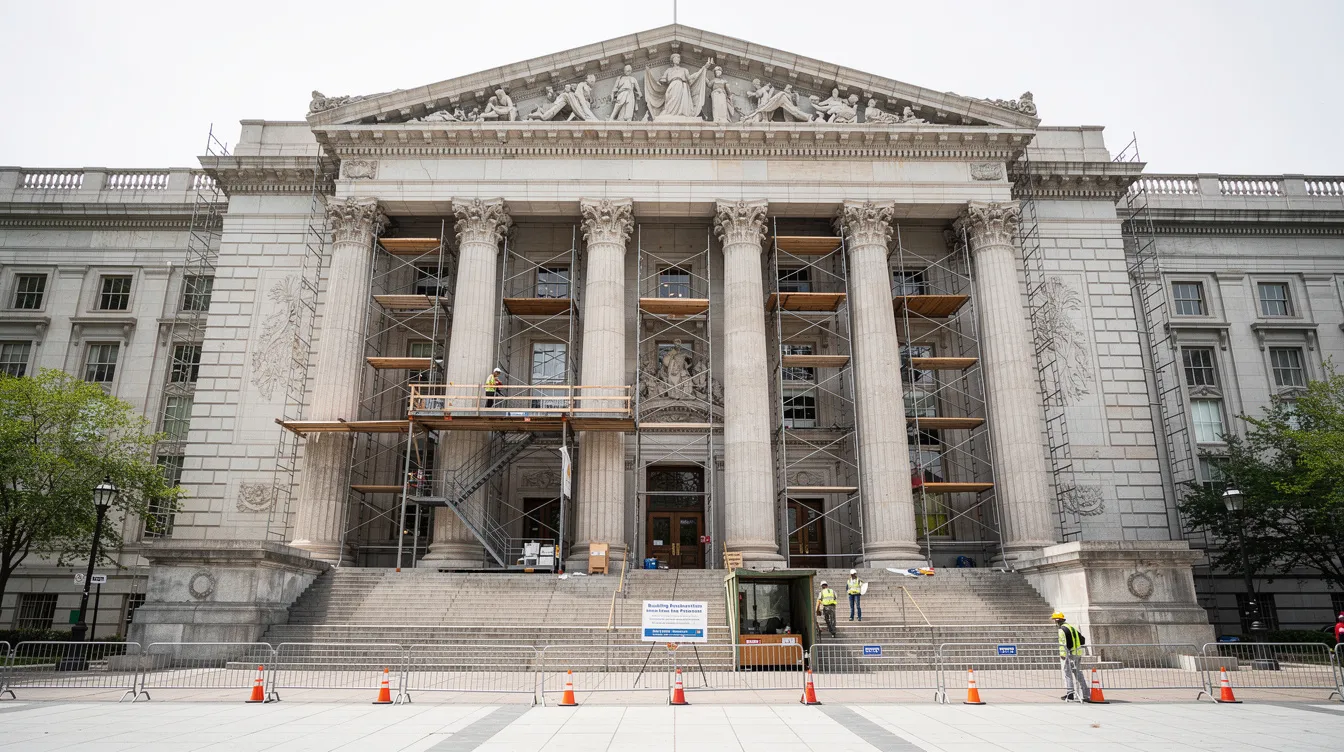
The Tennessee War Memorial Building was completed in 1925 to honor World War I soldiers. At approximately 145,000 square feet, the neoclassical structure is listed on the National Register of Historic Places and houses both a historic auditorium and the Tennessee Attorney General’s Office. The recent restoration, led by Skanska USA Building under a CM/GC delivery method, began in February 2024 and is expected to be completed in early 2026.
The scope, as reflected in reporting from Construction Executive, includes accessibility and life safety upgrades, auditorium restoration, full MEP modernization, reconfigured office space, window and roof replacement, and careful exterior cleaning that respected original terra cotta, bronze, and granite. A light well originally filled in during 1958 was recreated to restore daylight to interior offices.
Renovation planning must consider both building and operational impacts, and this project models that complexity. Buildings account for approximately 40% of global carbon emissions, making the case for preservation over demolition stronger each year. Adaptive reuse extends buildings’ operational lifespans and can reduce construction costs by up to 16% compared to new construction.
Why this matters beyond the city of Nashville:
- The project combines historic preservation, complex MEP coordination, phased work around state operations, and intensive hidden condition risk.
- These constraints mirror similar building projects on courthouses, universities, healthcare facilities, and city halls in Knoxville, Chattanooga, and the Tri-Cities.
- Occupied building constraints, security requirements, and public scrutiny will feel familiar to any contractor renovating civic or healthcare facilities along the I-40, I-75, and I-24 corridors.
This is one more data point in a broader wave of public and institutional renovation work that defines the Tennessee Construction Outlook.
Historic Renovation Risk: Why It Is Tougher Than Ground-Up Work
Historic buildings and adaptive reuse projects carry a fundamentally different risk profile than new construction. The unknown is the enemy, and older buildings have decades of undocumented changes buried behind their walls.
Key risk categories include:
- Concealed deterioration in structural elements, building envelope, terra cotta, and foundation systems invisible until selective demolition or removal of finishes.
- Undocumented prior renovations, such as infilled light wells, rerouted utilities, or patches that do not match original structures.
- Obsolete or unsafe legacy systems, from knob-and-tube wiring to absent fire protection, often triggering full replacement rather than targeted repair.
- Hazardous materials like lead paint, asbestos, and dangerous coatings that require specialized abatement and compliance with regulations.
- Strict historic preservation authority requirements that slow approvals, mandate mock-ups, and constrain architect and engineer design flexibility.
A persistent problem: existing construction documents for buildings from the 1920s through the 1970s rarely match reality. Wall cavities, plumbing runs, and duct shafts are frequently undocumented, fueling scope gaps and change orders when ceilings and walls are opened.
Buildings may reveal unexpected conditions during demolition, and historic buildings often present unique hidden condition challenges that can eat margin fast. Experience helps manage hidden conditions effectively during renovations, but even seasoned teams get surprised. Adaptive reuse helps combat urban sprawl by using existing structures, yet the financial risk of getting it wrong means firms can lose money if they don’t plan for what they cannot see.
These risks translate directly to margin erosion: schedule extensions, stacked trades, overtime to maintain occupancy, and reputational risk with institutional stakeholders when disruptions to courts, classrooms, or clinics become too severe. ABC Greater Tennessee has explored related issues in its adaptive reuse lessons from the Wilder, and contractors should treat the War Memorial case as a further warning to tighten preconstruction diligence.
How Restoration Technology Reduces Hidden-Condition Surprises
No tool can eliminate all surprises in historic buildings, but restoration technology can turn unknowns into managed risks before construction starts.
Reality capture and scan-to-BIM: High-resolution laser scanning and photogrammetry can quickly capture irregular geometry, out-of-plumb walls, and undocumented shafts in older structures. That data feeds into coordinated BIM models used for clash detection. BIM reduces project rework and significantly limits waste. On the Vanderbilt Kirkland Hall renovation, laser scanning and shared BIM models during preconstruction helped deliver the $46 million project below budget and on schedule. Clash detection can save $500 to $25,000 per conflict, making the investment in scanning easy to justify.
Non-destructive testing: Ground-penetrating radar, infrared thermography, and ultrasonic testing identify voids, moisture, and structural concerns in slabs, vaults, and exterior walls without large-scale demolition. These tools help quantify risk before it reaches the field.
Digital documentation platforms: Drawing management, field photo logs, and issue tracking software preserve a defensible record of existing conditions, assumptions, and owner decisions. This documentation supports change order requests when new conditions emerge, saving money and protecting margin.
In the broader restoration technology landscape, similar data-driven approaches are transforming environmental work as well. Environmental DNA (eDNA) tracking detects the presence of species without physical capture, while predictive modeling helps allocate limited resources efficiently for ecological restoration. Genomic and biotech tools improve the resilience and diversity of restored populations, and digital planning and automated deployment bridge local successes with large-scale recovery efforts. These parallels underscore a central principle: whether the restoration target is a building or an ecosystem, better data drives better outcomes.
Firms looking to formalize these workflows should explore digital construction tools for Tennessee contractors as a framework for continuous improvement.
MEP Coordination In Historic Buildings: Why It Is A Different Puzzle
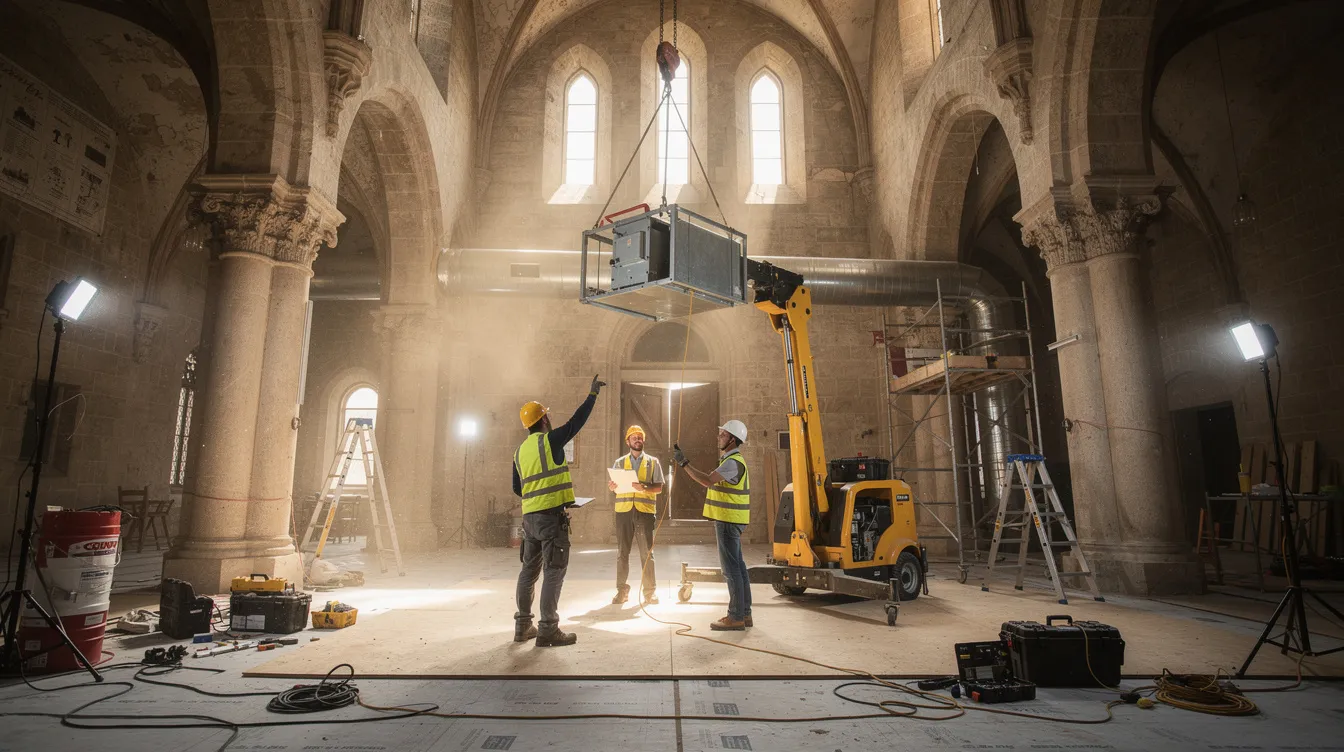
MEP coordination in an early twentieth-century civic building is a different process than in a new shell. Structure, finishes, and historic preservation rules limit penetrations, routing options, and visible elements at every turn.
Specific complications include:
- Shallow interstitial spaces and limited floor-to-floor height that constrain ductwork and piping.
- Thick masonry walls and undocumented chases that make it difficult to identify viable routes.
- Strict rules about visible diffusers, grilles, and fixtures in protected interiors like auditoriums, ceremonial rooms, and public lobbies.
- Legacy systems, such as the original terracotta tunnels reused for return air at the War Memorial Building, require detailed mapping before an engineer can determine whether reuse is feasible or full replacement is needed.
MEP systems can cost up to 60% of total project costs on complex renovations. MEP coordination starts in the Schematic Design phase, and effective MEP coordination can deliver projects faster when trades align early while also improving energy performance as modern systems are inserted into historic buildings. BIM fed by laser scan data helps mechanical, electrical, plumbing, fire protection, and low-voltage trades find viable routes that respect both structural and preservation constraints.
When coordination goes wrong, the consequences are immediate: rework costs when ductwork will not fit above historic plaster ceilings, schedule delays from unplanned shutdowns, and friction with AHJs over life safety upgrades in older egress paths. On related environmental challenges, bioremediation uses microorganisms to break down environmental pollutants in contaminated soils, a technique sometimes relevant when hazardous site conditions are discovered around older building foundations.
Tennessee contractors should use the War Memorial Building as a template to revisit their own internal MEP coordination checklists, especially for downtown Nashville, Knoxville, and Chattanooga projects that blend renovation, occupancy, and high-end finishes.
From Historic Preservation To Project Management Discipline
Restoration technology delivers results only when paired with disciplined project management. Strong scope definition, phasing, stakeholder communication, and documentation are just as essential as the scanning hardware or the cleaning laser.
Practical project management tactics for historic work include:
- Early coordination meetings that include preservation consultants, facility staff, and the full trade team so that constraints are identified before they become schedule problems.
- Detailed phasing plans to maintain government or campus operations while protecting finishes and managing access.
- Clear chain of command for rapid decisions when site conditions diverge from drawings.
Ethical practices improve project outcomes and stakeholder trust, especially on high-profile public projects where community scrutiny is constant. Emerging trends in restoration highlight the importance of combining technology with community engagement, and community-driven monitoring expands data coverage and improves restoration accountability on both building and environmental projects.
ABC Greater Tennessee members can leverage association education, ConstructionU management training, and STEP safety programs to build the leadership and safety culture these projects demand. Restoration technology should feed into daily superintendent and foreman routines, not sit in a silo with VDC staff. Project management must translate models and scans into field-friendly sequencing and safety planning.
Bidding Strategy: Contingency, Allowances, And Construction Documents For Historic Work
Profitable historic renovation starts long before mobilization, in how estimators and project managers structure their bids, qualifications, and contracts. Getting this phase wrong is how contractors lose money on adaptive reuse projects that looked promising at pursuit.
Recommended pre-bid actions:
- Conduct multiple site walks with specialty subcontractors (stone, plaster, metal finishing, historic windows) to identify possible hidden issues.
- Submit written RFIs for missing as-built information and seek owner alignment on assumptions and exclusions.
- Commission selective destructive testing where permitted to verify materials, including masonry strength, plaster composition, and presence of hazardous materials.
- Build explicit contingencies and allowances tied to investigative findings and known unknowns, rather than generic percentage adders that stakeholders may resist.
- Document assumptions, exclusions, and unit pricing for potential added scope. This documentation protects contractors when hidden conditions surface. ABC Greater Tennessee’s construction risk management checklist supports this discipline.
Industry projections indicate that 90% of new real estate development will involve adaptive reuse by 2033, and adaptive reuse projects can revitalize impoverished communities across Tennessee. This means the pipeline of complex renovation work is growing, and the businesses that develop disciplined estimating, scheduling, and contract language now will save time and budget on every future bid.
Contractors should also review guidance on protecting margin before bids go out, connecting restoration technology data with stronger financial controls.
Statewide Implications: From Nashville Landmarks To East Tennessee Campuses
The renovation backlog is not limited to Nashville. Across the ABC Greater Tennessee footprint, including Knoxville, Chattanooga, Kingsport, Johnson City, Bristol, and the I-40, I-75, and I-24 corridors, similar opportunities and risks are developing.
Building types that will see similar restoration technology demand:
- University libraries and lecture halls with aging infrastructure.
- Older hospitals and clinics requiring code and accessibility upgrades.
- County courthouses and civic structures with undocumented conditions.
- Historic theaters and early-to-mid-century office towers being converted through adaptive reuse.
Contractors who master restoration technology and preconstruction discipline can identify and capture work that less prepared competitors cannot manage. But there is a constraint: with skilled trades in short supply, firms that invest in workforce development, apprenticeship, and safety-focused operations will be best positioned to execute complex restoration without burning out crews.
The War Memorial Building is a preview of the next decade’s renovation backlog across Middle and East Tennessee. Leaders who understand the trend will plan accordingly; those who don’t will carry more risk with less margin.

Workforce, Safety, And Training For Restoration Projects
Advanced restoration technology still depends on highly trained craft professionals and supervisors. Training in construction trades is essential for project success, especially in disciplines like electrical, carpentry, plumbing, HVAC, and masonry that are heavily involved in historic buildings.
Safety concerns on restoration work are distinct:
- Working at height on historic facades with specialized fall protection.
- Handling lead-based paint and asbestos-containing materials under strict regulations.
- Confined spaces in old mechanical rooms with limited ventilation.
- Coordinating multiple trades in tight, irregular spaces where standard planning templates do not apply.
The data supports investment. Safety training reduces workplace accidents by 30%. Construction firms with safety training see 50% fewer injuries. Over 70% of construction accidents are preventable with training. These are not abstract numbers; they are the difference between a profitable phase and an OSHA citation that stops work.
Construction education strengthens industry professionals’ skills, and workforce development programs improve job readiness in construction. Effective workforce development reduces project delays and costs, while collaboration in training enhances skills across construction disciplines. These advantages compound over time for firms that commit to the process.
ABC Greater Tennessee’s Construction Trades Academy and related apprenticeship programs are practical pathways for building the restoration-capable workforce that Nashville and East Tennessee need. Contractors who develop this talent internally will manage resources more effectively and deliver the quality that preservation work requires.
Next Steps For Tennessee Contractors Considering Their Next Historic Bid
Restoration technology is now part of competitive advantage in Tennessee’s civic, healthcare, and higher education renovation markets. Contractors who ignore it will carry more risk for less margin on building projects that are only growing in complexity.
First moves:
- Audit current renovation project management practices and identify gaps in documentation, coordination, and field communication.
- Evaluate access to scanning and BIM capabilities, whether in-house or through partnerships with specialty consultants.
- Review contract templates and allowances for hidden conditions; ensure assumptions and exclusions are clearly developed and reflected in every bid.
- Assign internal technology champions in preconstruction or operations who can drive workflow improvements.
Connect with ABC Greater Tennessee for support, whether through membership, management and safety education, or apprenticeship options to deepen a restoration-ready team. Review association resources on Tennessee Construction Outlook, digital construction tools for Tennessee contractors, and the construction risk management checklist as you prepare your next round of bids.
Merit shop contractors in Greater Tennessee are well positioned to lead on complex restoration and adaptive reuse work. The firms that align technology, training, and disciplined project management will not just preserve Tennessee’s architecture; they will protect their own future profitability doing it.
FAQ
These questions address practical concerns Tennessee contractors commonly raise about restoration technology and historic renovation work.
How is restoration technology different from general construction technology?
Restoration technology focuses on investigating, documenting, and carefully intervening in existing historic buildings, while general construction technology often targets new-build efficiency, layout, and production tracking. Examples include laser cleaning of stone and metals, non-destructive testing, and scan-to-BIM modeling, which are tools more common in preservation than on typical tilt-wall or greenfield projects. A firm that specializes in renovation work will encounter these tools far more frequently than one focused on ground-up construction starts.
Do smaller Tennessee contractors need full in-house BIM and scanning teams to compete?
Many firms start by partnering with specialty scanning and BIM consultants rather than building full internal capability. What matters most is the ability to interpret and apply the data in estimating, scheduling, and field coordination. Those skills can be developed over time through association resources, targeted training, and repeated project experience.
How early in design should restoration technology be used on a historic project?
Engage scanning, non-destructive testing, and preliminary BIM work as early as schematic design when possible. Findings can then influence programming, budget ranges, and constructability reviews. Waiting until after construction documents are issued almost always leads to more redesign, change orders, and schedule disruption when hidden conditions are uncovered during demolition.
What kinds of historic buildings in Tennessee are most likely to benefit from restoration technology?
Concrete examples include downtown Nashville and Knoxville office towers from the 1920s through the 1960s, county courthouses, early hospital wings, historic schools, theaters, and civic buildings in Chattanooga and the Tri-Cities. Any project with limited as-built documentation, aging MEP infrastructure, and preservation or adaptive reuse goals is a strong candidate for these tools and methods.
Where can contractors learn more or upskill their teams for this kind of work?
Tap resources like ABC Greater Tennessee’s Construction Trades Academy, ConstructionU courses, OSHA training, and peer networking to understand how other members are using restoration technology in the field. Reviewing association content on the Tennessee Construction Outlook, adaptive reuse lessons from the Wilder, and digital construction tools for Tennessee contractors provides a practical learning pathway for firms at any stage of adoption.